
AI that earns its place

Timur Mutyshev in sunglasses and a black knit polo

I design AI products that make someone’s day a little easier. The model does the heavy lifting, the person stays in control, and nobody has to squint at a chatbot wondering if it’s right.

Selected work 2025 to 2026

AI, put to work.

Products where AI does real work for real people, and the calls I made about where it shouldn’t.

Social Nature

A brand portal with an AI analyst built in

Role
Senior product designer
Team
1 PM, 5 engineers, me
Time
12 months, in production
Space
CPG, AI reporting
Phase 1: Find the work
Phase 2: Ship and measure

Brands ran a campaign, then waited. Waited on kickoff calls, waited on Customer Success to set things up, and waited again for someone to pull the results into something they could take to a retailer. Launching took weeks. Proving it worked took longer.

Social Nature Brand Portal sign-up screen on a laptop
AI retailer report
≤ 5 min
Feature adoption
68%
Ops team lift
49%

Prototypes you can click through

3 live files
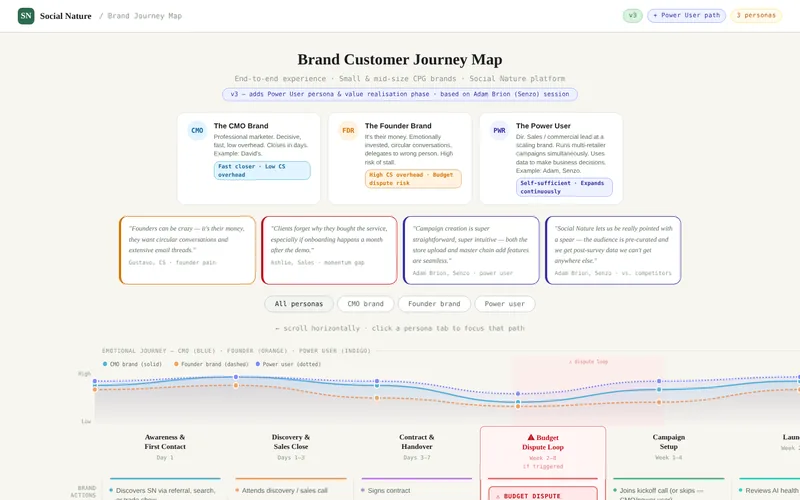
  1. Research Customer journey map Three brand personas end to end, with the emotional arc and where the budget dispute loop starts.
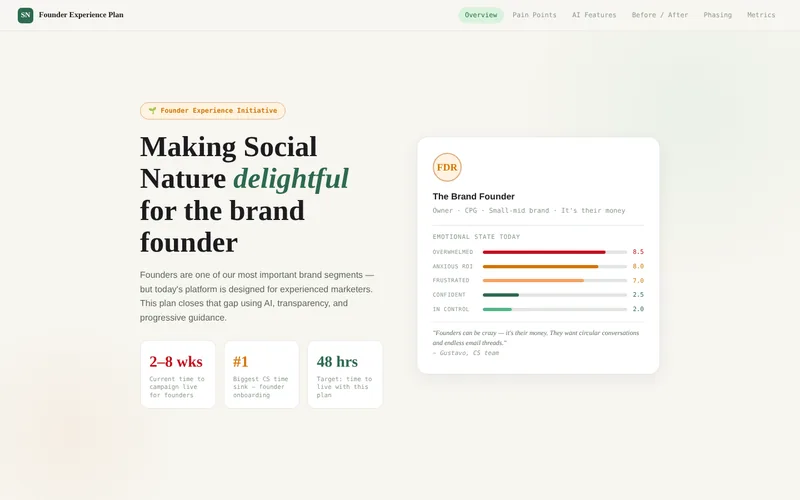
  2. Research Founder experience plan Pain points, AI features and phasing to make the platform work for small-brand founders.
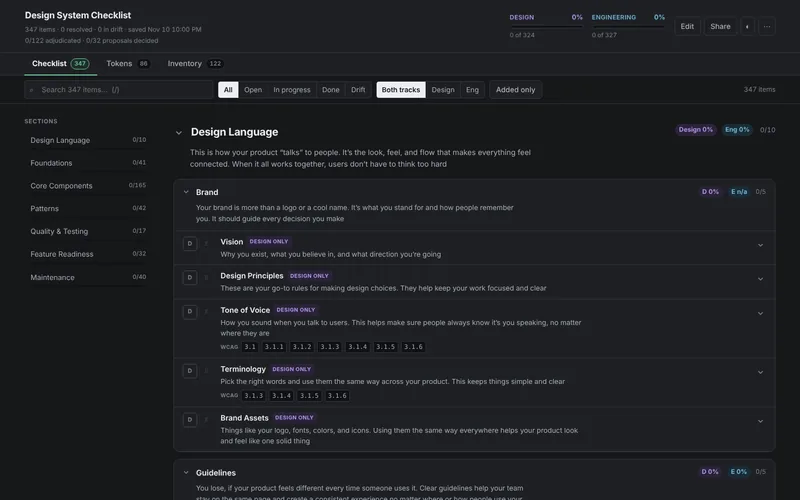
  3. Design system Design system checklist 347 checks across design and engineering, with 86 tokens, a 122-component inventory and WCAG links.

Edgesss

A trading journal that takes seconds, not minutes

Role
Founder, designer and PM
Team
1 engineer, me
Time
3 months, in production
Space
FinTech, behavior
Phase 1: Cut the friction
Phase 2: Ship and measure

Most traders don’t have a strategy problem. They have an execution problem: breaking their own rules, trading on impulse, making the same mistake on repeat. Journaling is the fix everyone knows about and almost nobody sticks with, because logging a trade takes the exact discipline they’re short on.

Edgesss landing page on a laptop: Trade smarter by understanding yourself
Retention at 90 days
42%
Deeper sessions
3.1×
Interaction time
< 80ms

Experiments

Things I built to find out what AI is actually good for. Newest first.

Local AI

Year
2026
Made with
ComfyUI, open models
The what if
What if I ran the models myself, on my own machine, instead of renting them through someone else’s app?
What I made
A local ComfyUI setup with node-based workflows that run open image models on my own hardware. No cloud, no per-image cost, and every step of the pipeline in plain view.
What it taught me
Once you can see the pipeline as nodes, the black box gets a lot less black. You start designing for where it breaks, not just for the happy result.

Pipeline

Year
2026
Made with
Claude API
The what if
What if outreach drafted itself, but you still hit send?
What I made
A lead pipeline app for Mokofo: kanban, leads table, email sequences, analytics, and an AI compose step on the Claude API that writes the first draft for each lead.
What it taught me
AI is great at the blank page and bad at knowing when to stop. The draft is the easy part. The design is the review step.

When AI gets hard

The models change every few months. How I think through the problem mostly doesn’t. Most of my work starts with something complicated that needs to feel simple, and these days there’s usually a model in the middle of it.

Pick the one that sounds like your team.

How I’ll show up on your team

  • Close to customers. I’ll ask to be on discovery calls early, not handed a brief later.
  • Close to engineering, and to the model. I prototype with real AI output, not lorem ipsum, from the first Figma file through production QA.
  • Built for remote. I’ve worked remote and async for years.
  • Comfortable leading. I’ve managed a small team of designers and pitched to enterprise customers directly.
Toolkit Models included

Skills up my sleeves

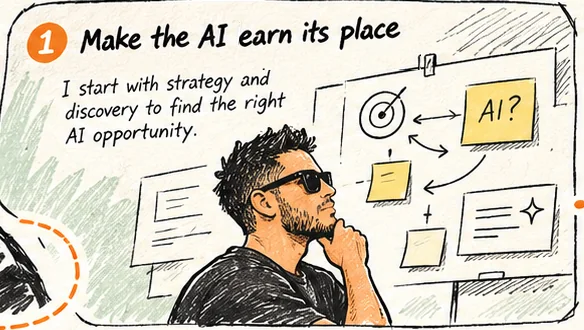
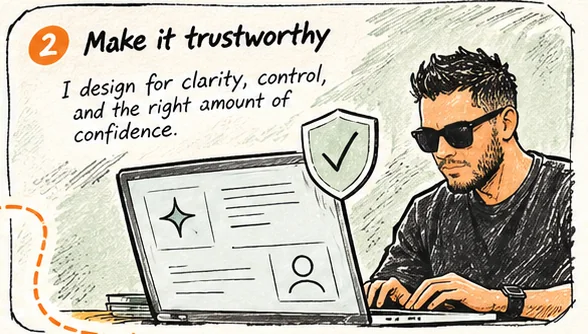
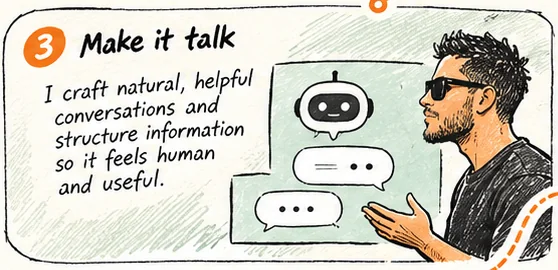
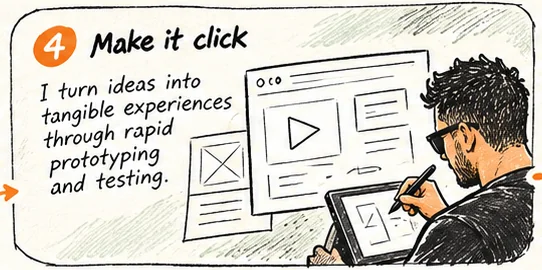
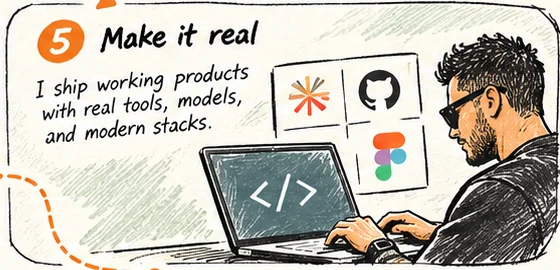
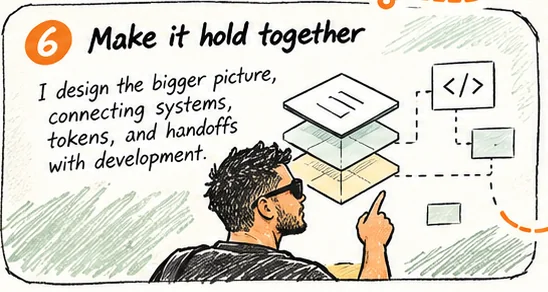
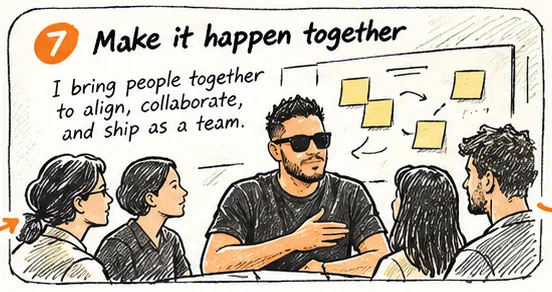
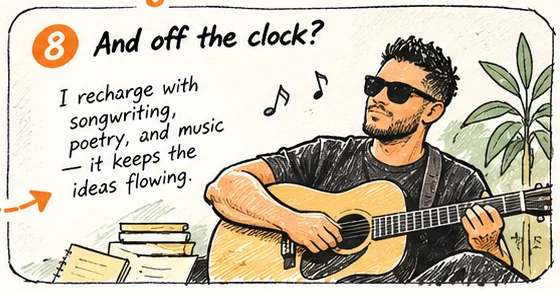
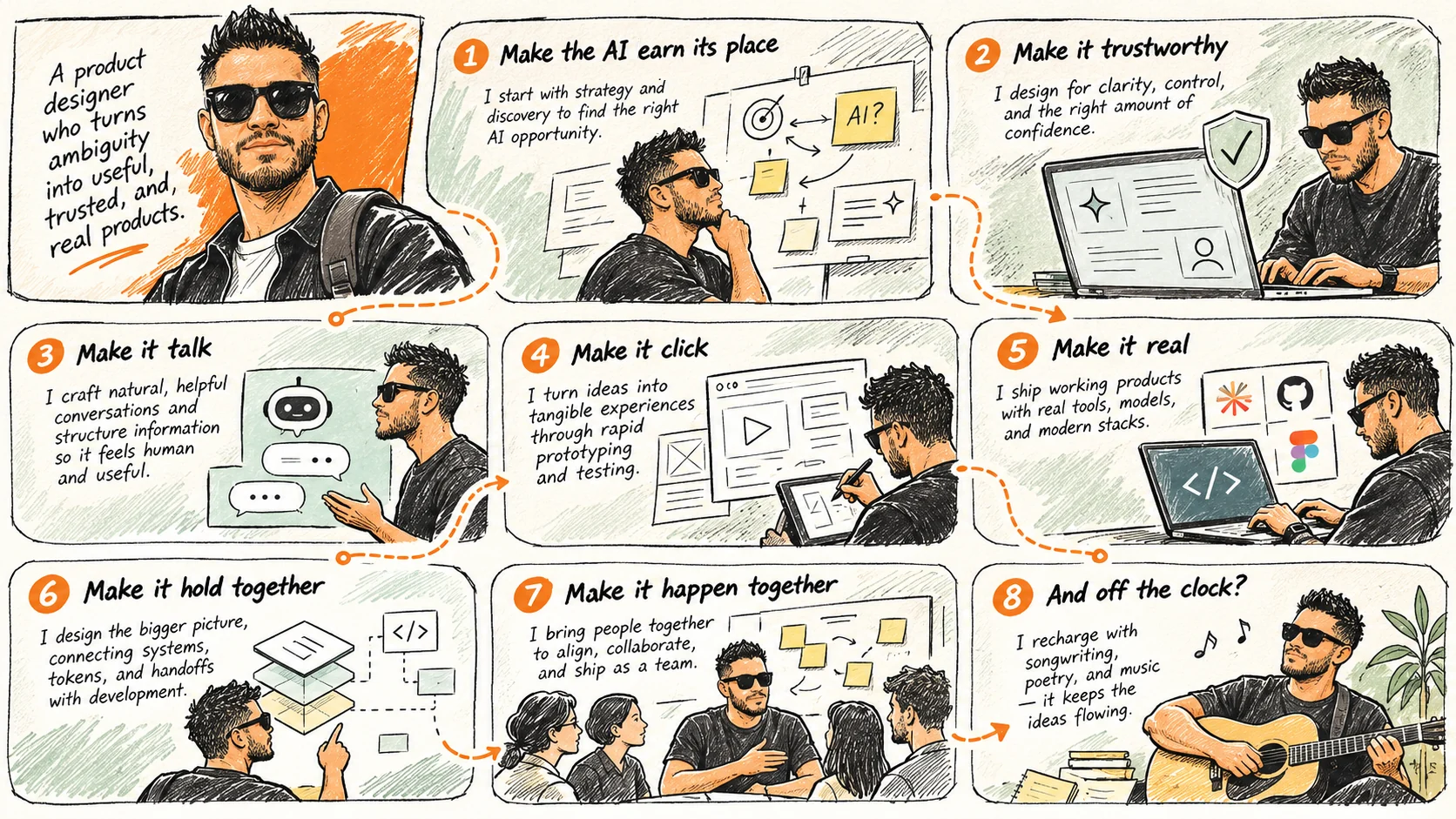
Illustrated storyboard of how I work, in eight panels: Make the AI earn its place: I start with strategy and discovery to find the right AI opportunity.; Make it trustworthy: I design for clarity, control, and the right amount of confidence.; Make it talk: I craft natural, helpful conversations and structure information so it feels human and useful.; Make it click: I turn ideas into tangible experiences through rapid prototyping and testing.; Make it real: I ship working products with real tools, models, and modern stacks.; Make it hold together: I design the bigger picture, connecting systems, tokens, and handoffs with development.; Make it happen together: I bring people together to align, collaborate, and ship as a team.; And off the clock?: I recharge with songwriting, poetry, and music. It keeps the ideas flowing.
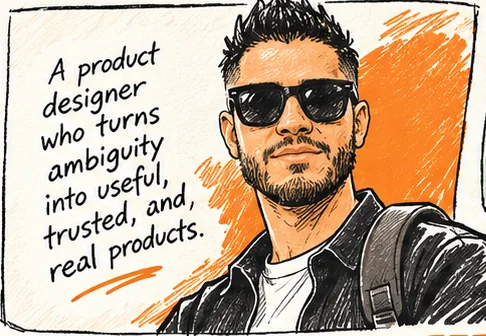
  1. A product designer who turns ambiguity into useful, trusted, and real products.
  2. Make the AI earn its place: I start with strategy and discovery to find the right AI opportunity.
  3. Make it trustworthy: I design for clarity, control, and the right amount of confidence.
  4. Make it talk: I craft natural, helpful conversations and structure information so it feels human and useful.
  5. Make it click: I turn ideas into tangible experiences through rapid prototyping and testing.
  6. Make it real: I ship working products with real tools, models, and modern stacks.
  7. Make it hold together: I design the bigger picture, connecting systems, tokens, and handoffs with development.
  8. Make it happen together: I bring people together to align, collaborate, and ship as a team.
  9. And off the clock?: I recharge with songwriting, poetry, and music. It keeps the ideas flowing.

I’m the person who keeps asking “why?”

Lately the question is “why is the AI here?” I care about what happens on the other side of the screen: whether someone trusts what the product just told them, finds what they need, or gets a little time back.

Start with the person. Then decide if the model should help.

I get close to the problem first and find the work people are still doing by hand. Only then do I reach for AI. I prototype with real model output early, because AI products fall apart in the edge cases, not the happy path.

I bring a point of view, and enough curiosity to change it.

There’s a person behind all these prompts.

Someone who follows rabbit holes, notices tiny things, and occasionally turns a perfectly ordinary afternoon into a new project. Off the clock, that’s usually music.

Have a look around. Make yourself curious.

I learned trust the hard way.

Before AI, I spent years on enterprise telecom and FinTech, where a wrong number costs a real customer. Same job now, with a model in the loop.

Cloud Calling for Microsoft Teams, monthly subscribers
32K to 500K+

Building something with AI in it? Half-formed thoughts welcome. You don’t need a polished brief, or a finished model, to start a good conversation.